News
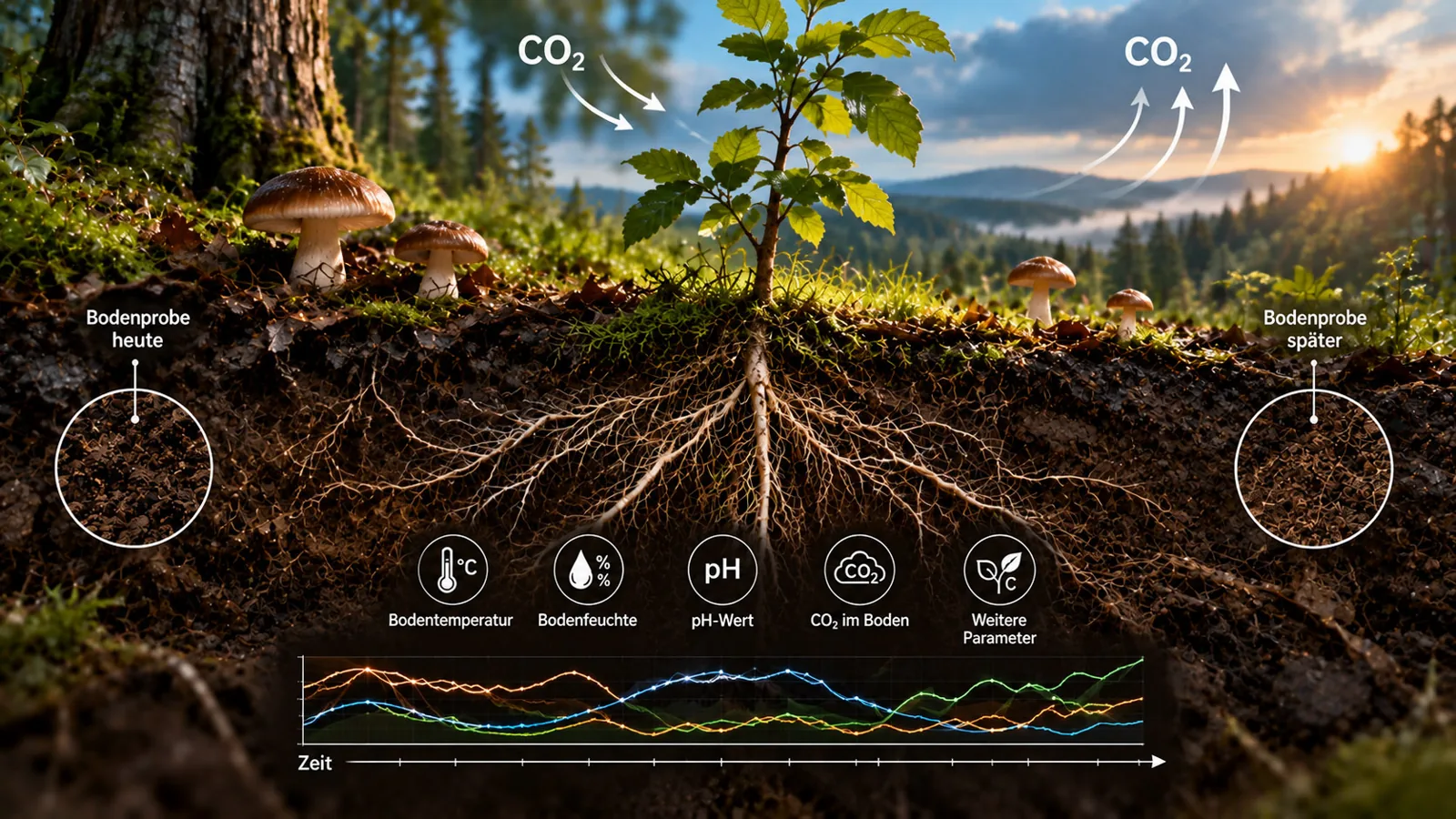
What if we could see what happens in the soil between two soil samples?
ℹ️ Hinweis: Die Bilder in diesen Beiträgen sind KI-generiert.
← Alle NewsWhat if – a thought experiment – Part 3
17.09.2026 · en
The applications described here have not been demonstrated. This series asks what might become possible if future measurements reveal reproducible patterns.
What if we could see what happens in the soil between two soil samples?
Plants absorb CO₂ from the atmosphere and use its carbon to build biomass. Some of that carbon enters the soil through their roots. Mycorrhizal fungi are also involved in this flow of carbon.
What happens to the carbon afterwards is complicated. Some of it is broken down and eventually returns to the atmosphere. Some may remain in the soil for much longer.
But what happens in between?
Soil samples can tell us how much organic carbon is present in the soil at a particular point in time. That is important. But a sample is still only a snapshot.
Suppose we take a sample today and another one several months or years later. In between, plants have grown, fungi have extended their hyphae, microorganisms have broken down organic matter, and periods of drought and rainfall have changed the soil.
All of that happened. We just weren't watching all the time.
What if bioelectrical measurements could fill in part of that gap?
Not by allowing us to read directly from an electrical signal how much carbon is being stored in the soil. We cannot do that.
If certain changes in the electrical activity of a mycelial or mycorrhizal network repeatedly occur alongside measurable changes in the carbon cycle, patterns might begin to emerge.
To investigate this, electrical measurements would have to be combined with other data: soil moisture, temperature, CO₂, soil chemistry and actual measurements of soil organic carbon.
Only then can we find out whether the signals are actually related – and whether the same thing happens again.
Maybe we find a pattern. Maybe we don't. Either way, we have learned something.
That takes a lot of measurements, collected over long periods and at different locations. This is exactly the kind of data we want to collect with OpenMycoNet.
Soil carbon also plays a role in climate accounting and carbon credits. Anyone claiming additional carbon storage in soil needs to measure and demonstrate it. There has been an ongoing debate about how reliably these changes can be measured and how long the carbon actually remains in the soil.
BioComm would not replace those carbon measurements.
But perhaps its data could show us something about what happens in the living system between two soil samples.
Maybe those data will eventually support some of today's assumptions. Maybe they will show that we have been looking in the wrong place.
We are not here to prove either one.
We want to measure what actually happens.
And if we find relationships that keep showing up?