News
What if a plant needs help before we can see it?
ℹ️ Hinweis: Die Bilder in diesen Beiträgen sind KI-generiert.
← Alle NewsWhat if – a thought experiment – Episode 4
18.09.2026 · en
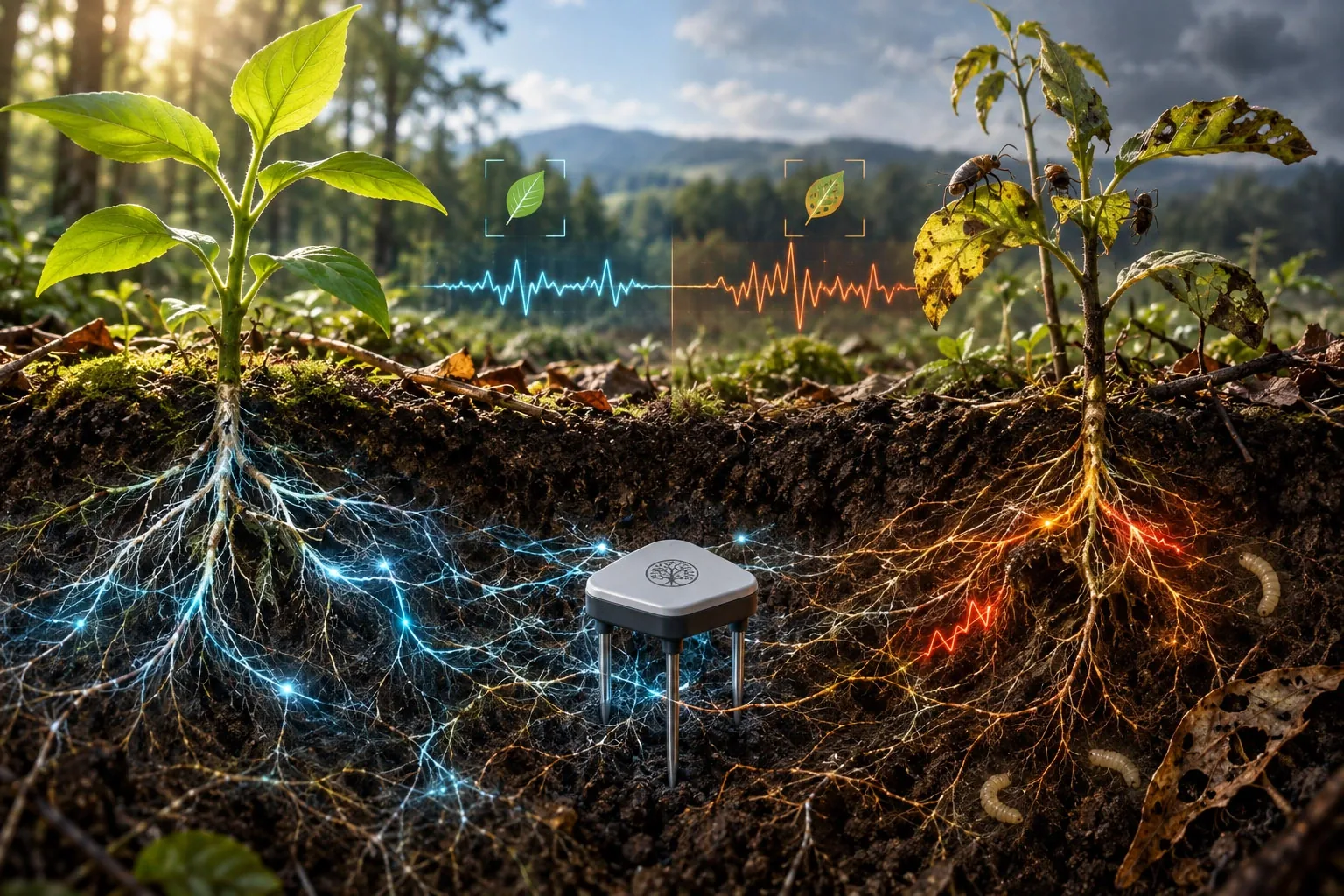
The applications described have not been proven. This series asks what could become possible if future measurement data shows reproducible correlations.
A sick plant doesn't look sick from the very first moment.
By the time leaves change color, growth stops, or damage becomes clearly visible, changes may have long since taken place within the organism and its immediate surroundings.
But does something happen in the process that we can measure electrically?
Plant roots don't stand alone in the soil. Many are connected to mycorrhizal fungi. Add to that bacteria, other fungi, and countless other organisms. It's a biological system where something is constantly happening.
When a plant comes under stress, this system changes. The cause can be pathogens or pests, but equally drought, nutrient deficiency, or other changes in its environment.
That's far from meaning that a mycorrhizal network tells us:
"Tree number 17 has a bark beetle."
or
"Help, I have a phosphorus deficiency."
It probably won't be that simple.
Something else would be interesting.
Suppose certain types of stress on a plant are repeatedly accompanied by changes in electrical activity in the connected fungal network. Not just once, not just in one plant, and not only under laboratory conditions.
Then we'd first of all have a pattern. Not yet a diagnosis.
We'd then need to check whether this pattern is actually connected to the stress. And after that, whether different causes can even be distinguished from one another.
Drought can stress a plant. So can a fungal infection. Feeding damage, nutrient deficiency, or injury too.
Maybe the electrical changes look different each time.
Maybe not.
That's exactly what measurements would need to show.
But if certain patterns repeat across many trials and under different conditions, an early warning system could eventually emerge from this.
Not one that diagnoses diseases from a single voltage curve. But one that says:
Something has changed here. Take a closer look.
Even that could be interesting for agriculture or forestry. You wouldn't have to wait until a change has become large enough to spot with the naked eye.
BioComm could observe electrical activity together with environmental parameters over a longer period of time. If anomalies occur, they'd need to be compared with the actual condition of the plant, fungus, and soil.
Only from many such comparisons could it become clear whether we're actually detecting something – or whether we've just mistaken noise for a signal.
We need to be able to tell the two apart.
And if that works out?
What if a problem in the soil or with a plant were already measurable before we even know we should be looking for it?