News
Mycelist, Hyphist, Sporist – three roles, one network
ℹ️ Hinweis: Die Bilder in diesen Beiträgen sind KI-generiert.
← Alle NewsThree unusual names for three different ways of being part of OpenMycoNet
14.09.2026 · en
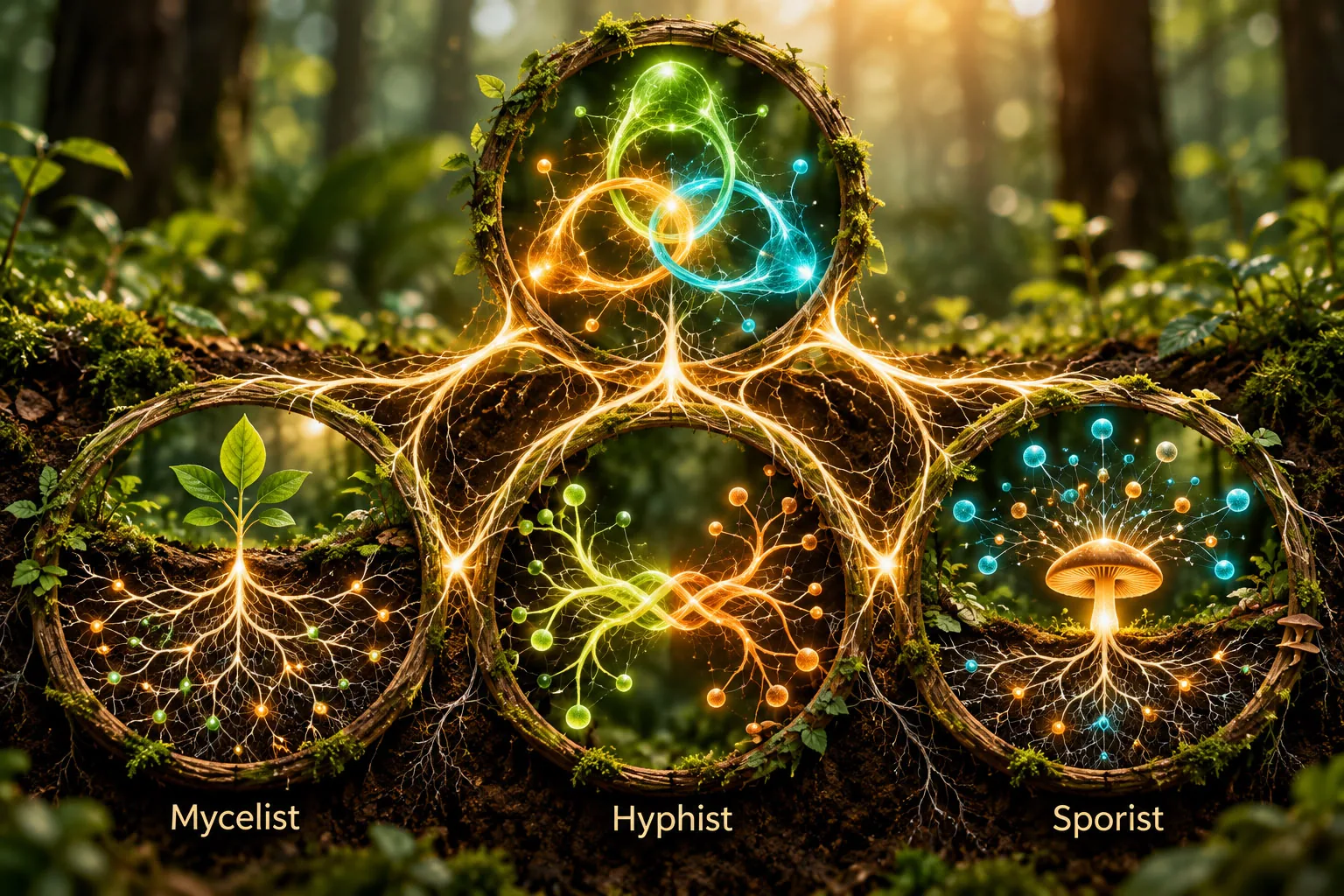
Anyone taking a closer look at OpenMycoNet will sooner or later come across three terms that are not exactly self-explanatory: Mycelist, Hyphist and Sporist.
We could, of course, have kept things simpler. Member, collaborator and supporter would have worked as well. But OpenMycoNet is about networks – so it seemed fitting to think of the people behind the project as parts of a network too.
The three names therefore describe different ways of participating in OpenMycoNet. They are not ranks, and they say nothing about how “important” someone is to the project. A Mycelist is not less valuable than a Hyphist, and a Sporist does not stand above either of them.
They are simply different roles within the same network.
Why these names?
The names were not chosen at random.
The mycelium is the widely branching network of a fungus. It consists of countless fine fungal filaments called hyphae. And spores allow fungi to spread and establish new growth elsewhere.
We transferred this image to OpenMycoNet.
The Mycelist represents the community – the larger network that emerges when many people become part of it.
The Hyphist takes its name from the hyphae. Together, they form the mycelial network. For us, this is a fitting image for people who contribute their expertise and connect OpenMycoNet with other fields through collaboration.
And finally, the Sporist. Like a spore, a Sporist helps create the conditions for something new to emerge and grow elsewhere. At OpenMycoNet, this happens through financial support or other resources.
So the names describe more than three roles. They draw on the same biological image behind the idea of OpenMycoNet itself:
Many different parts come together to form a network.
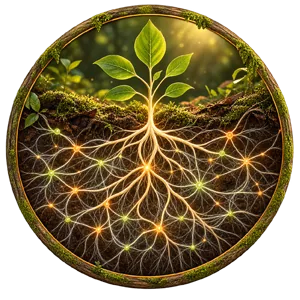
The Mycelist – part of the community
A Mycelist is essentially what elsewhere would probably simply be called a registered member.
Anyone who registers with OpenMycoNet can follow the project, keep up with its development and become part of the community. You do not need your own laboratory, scientific training or even a BioComm node in your garden or forest.
OpenMycoNet is not just about technology, measurements and research. The network also depends on people who follow the project, ask questions, contribute ideas or are simply curious about what we may eventually learn from many measurements.
A Mycelist does not have to do “more” in order to belong. Registration itself is already a form of participation.
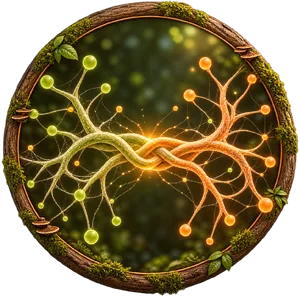
The Hyphist – when interest becomes collaboration
A Hyphist goes one step further. Hyphists are people or organisations who actively contribute their knowledge, experience or capabilities to OpenMycoNet.
For a project like ours, this is particularly important.
I am the developer and initiator of OpenMycoNet, but I am not a trained mycologist. That is certainly one reason to involve specialists. But it is far from the only one.
BioComm is not intended simply to record electrical signals. We want to measure under conditions that are as close as possible to the real world, identify relationships and eventually investigate how mycelial and mycorrhizal networks respond to targeted stimulation.
Technically, we may be able to determine quite precisely that something happened.
The much harder question is why.
This is where different disciplines become important. Mycology and plant sciences are obvious examples, but so are ecology, soil science, electrophysiology, data analysis and perhaps fields we have not even considered yet.
OpenMycoNet was not created to prove a predetermined hypothesis. If our measurements show something interesting, we must also be prepared to reject the most obvious explanation for it.
That requires people who question our methods, look at results from their own professional perspective and point out things we may have overlooked.
A Hyphist is therefore not someone we expect to confirm what we would like to hear.
Quite the opposite.
Good collaboration can sometimes mean someone telling us:
You are looking in the wrong place.
Perhaps you are reading this because your professional work involves fungi, mycorrhiza, plants, soils, ecosystems, electrophysiology or a related field.
Then your perspective may be exactly what OpenMycoNet needs.
Not because we are looking for someone to put a scientific label on the project after the fact. And not because we have already decided what our measurements are supposed to show.
We are looking for people willing to look at the questions with us. People who ask questions, point out mistakes, contribute their own experience and challenge an interpretation when the data does not support it.
That is what we mean by a Hyphist.
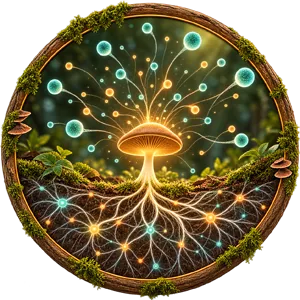
The Sporist – helping ideas become possible
And then there is the Sporist.
OpenMycoNet is an independent project. But independence does not mean that development, hardware, field testing, servers, communication and eventually the operation of a distributed measurement network come without costs.
Sporists support OpenMycoNet financially or through other resources. Their contribution creates possibilities that we could otherwise not realise – or could realise only much more slowly.
There is an important distinction here as well:
Supporting OpenMycoNet does not mean buying influence over its results.
A Sporist does not fund a desired conclusion. A Sporist helps make it possible to investigate the question in the first place.
That distinction matters to us.
So who operates the nodes?
At this point, you might expect a fourth role.
There deliberately isn't one.
Operating a BioComm node is not a separate role within OpenMycoNet. A node can be operated by a Mycelist, a Hyphist or a Sporist. Running a node is an additional task within the network, not another level in a hierarchy.
We are also providing a shared workspace for node operators and Hyphists. It is intended not only for communication. Specific tasks and research questions can also be defined and worked on together.
How that works – and why this part of OpenMycoNet matters to us – deserves a separate article.
Because at that point the question is no longer just who belongs to the network – but how the network works together.